
Agartha is perhaps the longest-running legend about a “lost” or “hidden” kingdom in the world. Typically referred to as a “mysterious civilization,” it is often associated with Shambhala; ancient wisdom; the network of secret tunnels beneath the earth; spiritual teachers; and the Hollow Earth Theory.
However, the origins of the modern Agartha legend are much more complex – and fascinating than this commonly-held notion of a subterranean civilization.
The roots of the modern Agartha legend have grown out of a combination of Asian religious traditions; Western esoteric movements; travel writing; Hollow Earth theories; and popular imagination.
Perhaps most important to note, however, is that Agartha and Shambhala are not simply two ancient names for the same location.
Over time, their association evolved through combining different traditions and narratives. Understanding how these associations developed demonstrates why the Agartha legend remains so captivating to many people today.
What Is Agartha?
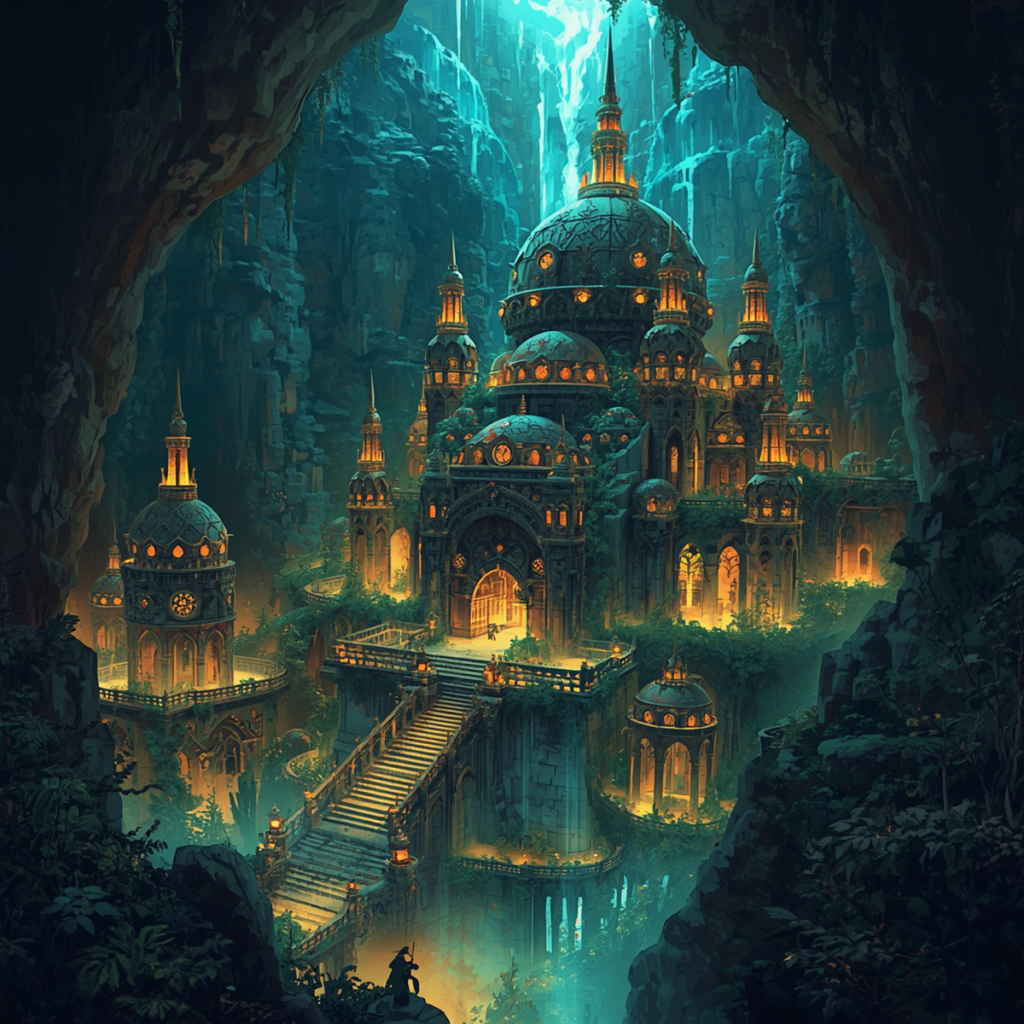
The name “Agartha” has been used recently in Esoteric Literature to describe a Legendary Hidden Kingdom, that many have imagined as being somewhere under Central Asia or Inside the Earth.
There are numerous descriptions of Agartha. Many describe it as a huge underground society, inhabited by Spiritually Advanced People.
Many others describe it as a place where Ancient Wisdom resided and was governed by Enlightened Leaders. More Recent Descriptions of Agartha link it to a Vast Network of Underground Passages and Even a Hollow Earth.
Many Versions of the Name also exist such as Agarttha, Agharti and Agarthi.
While Modern Stories about Agartha will Sometimes Describe Agartha as having existed for Thousands of Years, the Documented History of the Legend of Agartha in the West is Much Shorter than this.
A major figure in that History was French Occult Writer Alexandre Saint-Yves D’alveydre.
The Origins of the Agartha Legend
The modern Western idea of Agartha developed most significantly in the late nineteenth-century.
In 1886, Saint-Yves d’Alveydre released Mission de l’Inde en Europe. That book contained an extensive description of a “hidden” spiritual center called Agarttha.
He wrote enough detail for much of what has since been said to be written about the mysterious underground kingdom. This represents a key difference as we examine the history of Agartha.
That is, although there were certainly very old mythological accounts regarding underground/hidden places, the fact that there existed some such accounts does NOT necessarily mean they allude to Agartha.
Writers often linked earlier religions into the new Agartha mythology.
As a result of this process of writing, a continually evolving mythology resulted.
Agartha and Shambhala
One of the most intriguing aspects of the Agartha myth is the relationship between Agartha and Shambhala.
In contrast to its modern Western connotations, however, Shambhala has a rich history in Tibetan Buddhism, especially the Kalachakra school.
In this tradition, it is considered to be a “spiritual” or “enlightened” kingdom that holds esoteric knowledge.
Shambhala cannot be equated with an underground city called Agartha.
These two concepts have their own histories based on different traditions.
Western authors and occultists later became involved in writing about these ideas, which ultimately led them to associate Shambhala and Agartha together.
Many contemporary accounts of Shambhala either represent it as the spiritual center of Agartha, or vice versa, as well as both as two distinct, yet related domains.
This ambiguity contributes to why tracing the modern mythology may be so complex.
The idea of the connection between Agartha and Shambhala did not exist in one form throughout all of antiquity.
Although the idea of an under-ground kingdom was first discussed by Agartha, there have been many other descriptions of sacred, un-accessible, sub-terrainian, or supernatural realms found in Asian religion traditions.
For example, in Hindu tradition, Patala refers to the lower world(s), and the Nagas are described as being powerful, supernatural beings that live in these lower worlds.
These descriptions can be found throughout many of the Hindu texts and traditions.
Similarly, Buddhist traditions also developed their own form of sacred geography. For example, they describe Shambhala (or Shang-Shung).
It would be easy to get caught up in this rich history when looking at Agartha mythology; however, we need to remember that just because two traditions deal with similar concepts does not mean that they are talking about the same thing.
This is particularly true today, as modern authors will often take the unrelated elements from each tradition, mix them together and then use this combination as proof of one single ancient underground civilization.
However, the truth is much more complex than that.
Why was Agartha identified as being home to a subterranean community?
A part of the reason is the cultural atmosphere of the late nineteenth and early twentieth centuries in Europe and North America.
There existed fascination among people in these regions with unknown lands; lost civilizations; esotericisms such as spiritualism; secret organizations; Tibet; India; Central Asia; and possibilities that there would be some kind of lost wisdom.
In addition to this interest in unknown areas, speculation concerning the configuration of the planet also began to develop.
These interests together provided a backdrop for myths regarding an under ground society.
Therefore Agartha had potential for being greater than simply a spiritual realm.
Agartha & the Hollow Earth Theory
The “Hollow Earth” theory developed independently from the “Agartha” theory.
In the Seventeenth Century astronomer Edmond Halley introduced a speculative model of the Earth consisting of concentric shells.
He attempted to explain why so much of what could be observed about the Earth appeared to be related to magnetic fields.
Later theorists greatly expanded upon these ideas in developing their own versions of the Hollow Earth theory.
Perhaps John Cleves Symmes Jr., who advocated for a hollow Earth and proposed that there were openings/holes to the hollow Earth at both north and south ends of the globe, is best known among modern Hollow Earth theorists.
These ideas have since been incorporated into mainstream literature. Many authors after the development of the Hollow Earth Theory connected it with theories of lost civilizations.
In fact, one example of a mythical internal world given to this space was named “Agartha”.
Thus, another offshoot of the mythology arose:
The underground kingdom, called Agartha, in a hollow Earth.
How the Agartha Story Spread
In the beginning of the 20th Century, travel literature contributed to a further growth in the Agartha Legend.
In his 1922 book “Beasts, Men and Gods”, Polish author and traveler, Ferdinand Ossendowski spoke of an underground kingdom known as Agharti.
Ossendowski’s story is now considered to be an important element in many modern western accounts of hidden or secret civilizations in Central Asia.
This time was very significant.
Many central Asian places were seen as mysterious and poorly understood by many Westerners.
Remote mountain ranges and deserts, Monasteries and ancient ruins as well as isolated communities were all easy subjects for speculation.
Therefore it was natural that Agartha would become embedded within this atmosphere of mystery.
These ideas; Stories of Shambhala, Secret Masters, Lost Civilizations and Underground Kingdoms eventually also started to influence one another.
Why Agartha Became Connected With Secret Knowledge
One reason the Agartha myth is so appealing to people today is it offers an opportunity for the kingdom to be viewed as a “depository” of old wisdom.
Many times the people who live in Agartha have been said to possess much greater wisdom than the rest of us on the outside do.
Since this image creates a great deal of story potential, and since we see the outside world as being less than perfect and less than able to hold onto what little knowledge it has developed (and because of our tendency to feel we’re missing out) – there’s a strong desire among many to believe that somewhere above or beyond where most of us can go, lies a community of people with much greater knowledge about things that have been forgotten by those of us living in the outside world.
Thus, instead of just describing geography, the “hidden kingdom” represents a belief that some of the highest truths exist beyond the awareness of ordinary humans.
Did Agartha Really Exist?
Although there has been no serious archaeological findings to validate the existence of an underground civilization called “Agartha”,
there are likewise no legitimate historical or factual sources that indicate that both Shambhala and Agartha existed at different points in time as one entity.
Furthermore, modern geology has failed to find support for the belief that a large subterranean area (or hollow earth) would exist within the Earth where a large human population could live.
We have learned about the interior of the Earth from all the geological data we’ve collected over many years; seismologists study earthquakes to understand how it works. The Earth can be divided into four main components which include:
- Crust
- Mantle
- Liquid Outer Core
- Solid Inner Core
The Myth of Agartha and Admiral Byrd
The connection between Agartha and American polar explorer Richard E. Byrd has also been one of the most popular legends about Agartha.
Subsequent accounts then allege that Byrd had come into contact with strange aircraft and/or beings representing an advanced civilization living within the Earth.
The stories on this topic were first promoted online as proof of Agartha.
Nonetheless, there is much controversy regarding the supposed Byrd Diary entries which are used by some as “evidence” of Byrd’s supposed encounters with unknown beings or craft and these Diary entries have not been verified and are considered unreliable as evidence of such encounters.
Byrd’s Diary accounts represent another illustration of how the legend of Agartha was able to continue evolving over time.
A story that began in the context of occult literature would be able to add onto it subsequent claims about polar expeditions; mysterious aircraft; UFOs; and other hidden civilizations etc.
Each additional component added more complexity to the overall legend.
How Myths Change Over Time
Something important to know from the Agartha mythos:
Most myths never remain unaltered in their entirety.
When a story passes from culture to culture; language to language; religion to religion; time period to time period; it changes interpretation.
What was once an ancient sacred kingdom becomes a medieval legend.
What was once a religious story or legend becomes an occult theory.
What was once an occult theory becomes a travelogue.
What was once a travelogue eventually becomes a conspiracy theory.
All of those forms can end up on-line with people referring to them as if they were part of one ancient tradition.
The mythos of Agartha shows us how that process works well.
It has multiple layers which have been created by different writers and/or movements during the last century plus.
Agartha, Shambhala & the Power of the Unknown
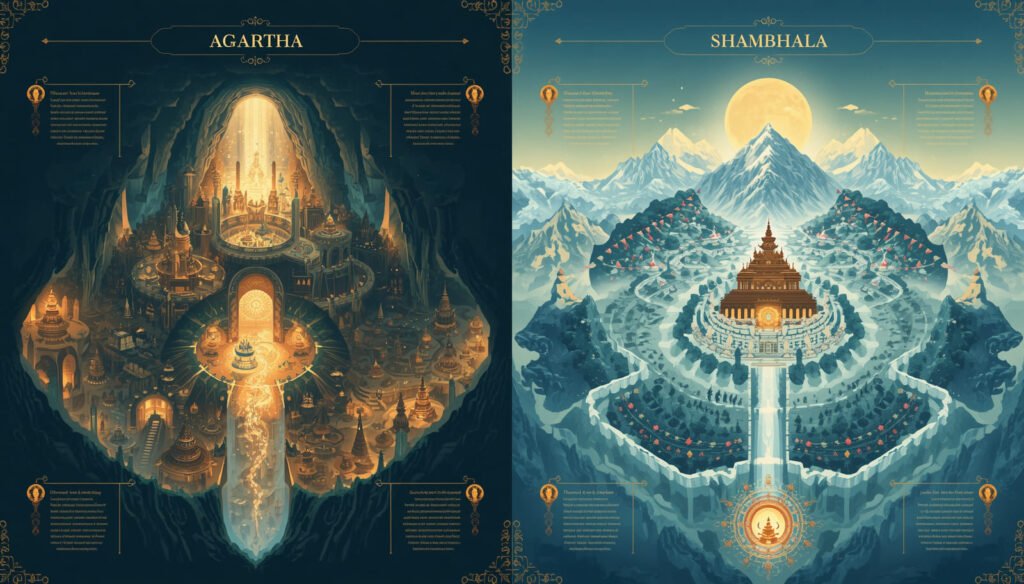
Geography aside, one factor contributing to why both Agartha and Shambhala endure as popular legends may be human imagination itself.
Agartha/Shambhala provide us with the idea of worlds that can potentially exist outside our normal experiences.
There is a secret world.
There is hidden knowledge.
There are individuals with access to knowledge which exceeds our own knowledge base.
Beyond the confines of our everyday world, there is another civilization awaiting discovery.
These concepts resonate with humanity because for thousands of years, humans have fantasized about unknown locations.
In the past, for example, these unknowns may lay beyond mountains far away or beyond the edge of the next body of water (unexplored).
During the middle ages, they could be found on the edges of maps.
By the nineteenth century, the unknown was located in Central Asia or at the polar extremes.
In today’s era, they can reside either underground, or somewhere beyond our solar system.
The location varies.