
The Great Pyramid of Cholula is one of the most amazing ancient structures in the world. It seems however, that relatively little attention has been directed toward it as compared to the pyramids located in Egypt. Situated in the State of Puebla, Mexico; the Great Pyramid of Cholula is recognized as the largest pyramid built (in terms of volume). Due to overburden from years of soil build-up along with extensive vegetation coverings, it resembles a small hill rather than a man-made monument.
Visitors to the site of the Great Pyramid of Cholula will have the opportunity to see firsthand, the many aspects of Mesoamerican culture. For those interested in traveling to this site, or learning about history and archaeology, this guide provides an overview on all facets of the pyramid and the visitation experience.
What Is the Great Pyramid of Cholula?
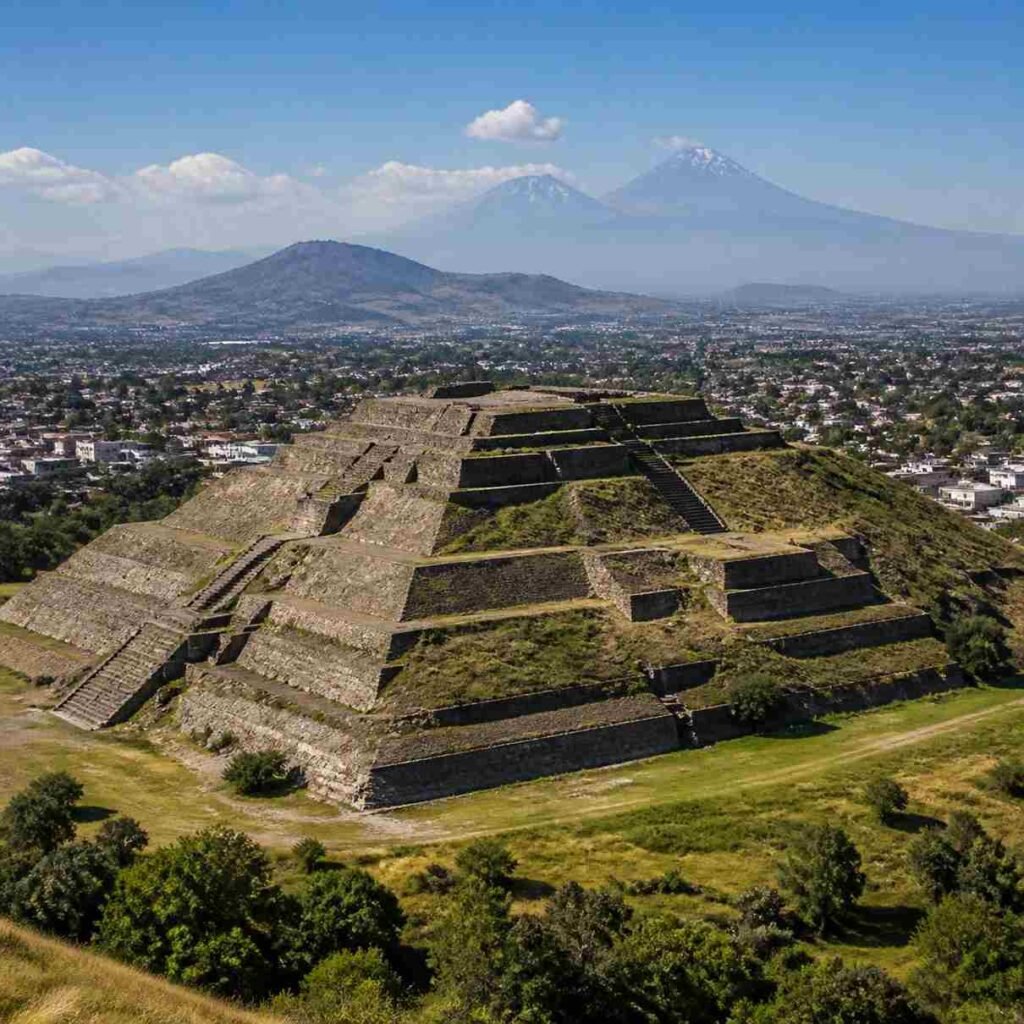
The Great Pyramid of Cholula, named Tlachihualtepetl in Nahuatl, meaning man-made mountain, is an old pyramid found in Cholula, Puebla, Mexico.
As opposed to the well-known pyramids in Egypt; this structure has much of it buried under layers of dirt and foliage. On top of the pyramid rests the Church of Our Lady of Remedies (Santuario de Nuestra Señora de los Remedios) built by the Spanish at the end of the 16th Century after they had conquered the Aztec Empire.
At first glance from afar, the pyramid appears as if it is simply a mound of land with a church situated atop of it. It was not until extensive archaeological excavation took place, that the true nature of the mound became apparent.
Why Is the Great Pyramid of Cholula Famous?
The Great Pyramid at Cholula is known for several things:
- It is the world’s largest pyramid in terms of volume.
- The total area covered is around 45 acres (approximately 18 hectares).
- Each side of its base is roughly 450 meters (1,480 feet).
- Approximately 4.45 million cubic meters; this is larger than that of Egypt’s Great Pyramid of Giza.
As such, it was used as a large-scale religious and ceremonial site for over a thousand years.
This massive scale combined with both historic significance and its ability to be almost invisible make it perhaps Mexico’s most interesting archeological site.
History of the Great Pyramid of Cholula
Construction began around 300 BCE but some archaeologists think some earlier phases date even earlier. Construction grew over many centuries rather than being built all at once. Different cultures added larger pyramids on top of earlier ones, much like nesting dolls.
Major phases of construction include:
- Early work around 300 BCE
- Continuous expansion from 100 CE to 600 CE
- Occupation during Classic and Postclassic periods
- Gradual abandonment before Spanish conquistadors arrived in 1519 By 1519
When Spanish conquistadors reached Cholula vegetation had already begun to grow over the structure and it looked like a natural hill.
Who Built the Great Pyramid of Cholula?
Unlike other famous monument constructed to honor a monarch, the Great Pyramid at Cholula has been built over several generations of native peoples.
Archaeologists have concluded that the earliest pyramid builders were likely influenced by the Olmec-Xicalanca cultures. The area also had subsequent people who inhabited it for thousands of years, but were affiliated with all or parts of the larger Mesoamerican religions.
Cholula would eventually become one of the regions’ greatest religious pilgrimage sites, attracting millions of pilgrims from central Mexico.
How Big Is the Great Pyramid of Cholula?
The large scale of the structure often surprises many that visit this site.
Dimensions of the Pyramid:
- Height: approximately 66 m or 216 ft.
- Base: approximately 450 m or 1,480 ft. on each side
- Area covered by the pyramid: approximately 18 ha or 45 ac.
- Volume: approximately 4.45 million cubic metres.
Why Does It Look Like a Hill?
The Pyramid has an interesting feature to do with how it looks.
The structure had been left to deteriorate for many years when the elements took their toll on it in the form of wind, rain, and vegetation that ultimately buried the structure under layers of soil. Vegetation in the area such as trees and bushes eventually spread across the surface of the Pyramid. It became almost invisible from the outside in comparison to the natural surroundings.
Generations later local people still thought of this mound as nothing more than a hill.
It would take archaeological investigation in the 20th Century to uncover the truth about this mysterious mound.
Church on Top
Church Of Our Lady of Remedies at the top has a nice view from where you can see:
- Popocateptl volcano
- Iztacchiuatl volcano
- Cholula
- Puebla
It was built in 1594, with this church the Spanish introduced their religion to Mexico, and today it is still used for religious services as well as provides a good view.
Inside the Great Pyramid
Visitors can explore parts of the pyramid through a network of extensive tunnels. Archaeologists have excavated approximately 8 kilometers (5 miles) of tunnels but only select sections are open to visitors.
Inside the tunnels visitors can see:
- Layers from ancient construction:
- Stone walls
- Adobe bricks
- Different phases of building
- Archaeological exhibits
These tunnels show how each civilization enlarged the pyramid over time.
Archaeological Discoveries
Excavations have unearthed a variety of artifacts that shed light on ancient Cholula.
Among the important finds:
- Ceramic offerings
- Burial sites
- Sculptures
- Mmurals and altars as well as religious artifacts.
One notable discovery is the mural of drinkers showing dozens of people apparently participating in a ceremonial drinking ritual.
These finds help archaeologists learn more about religion and society in Mesoamerica.
Religious Importance
Cholula has long been one of the most important pilgrimage sites in central Mexico. Likely dedicated to Quetzalcoatl, the Feathered Serpent who is associated with knowledge, wind, creation and civilization, thousands of pilgrims visited the site during important festivals and Cholula became one of leading ceremonial cities in the region.
Best Time to Visit
Ideal months are:
- November
- December
- January
- February
- March and April.
Generally these months offer nice weather with less rain. Morning visits also provide cooler temperatures and good lighting for photography.
The Great Pyramid of Cholula has many interesting facts:
- It is the largest pyramid in the world by volume.
- It took hundreds of years to build it.
- There are at least two pyramids that were built into each other.
- Atop this old pyramid there is a church.
- For thousands of years this was buried under vegetation.
- Archaeologists found miles of tunnels within its walls.
- This was an important place for religious ceremonies in Ancient Mexico.
- The name in Nahuatl (the language used when the Aztecs spoke) for this pyramid translates as “Man-Made Mountain.”
Tips for Travelers:
1. Wear good walking shoes because you will be doing a lot of walking.
2. Bring water and sun screen with you.
3. Go early in the day so you don’t get too much of a crowd.
4. Bring cash because many of the people who sell goods or services near the site do not take credit cards.
5. Respect all rules regarding the archeological site.
6. Make sure you check ahead of time if the tunnel system is open; otherwise you may end up going back home without being able to see it.
7. Plan enough time to go through the museum
FAQ
What is the Great Pyramid of Cholula?
The Great Pyramid of Cholula is a large Meso-American temple complex in Cholula, State of Puebla, Mexico.
In addition to being called the “Great Pyramid,” this massive edifice has another name that is even more descriptive.
It is referred to as Tlachihualtepetl, which translates to “the man-made mountain.”
Where is the Great Pyramid of Cholula?
This magnificent pyramid is found in the city of Cholula, in the Mexican State of Puebla. This location is roughly 62 miles east of Mexico City.
Who built the Great Pyramid of Cholula?
Construction of this massive pyramid began in the 3rd Century BC.
However, it was continuously modified and enlarged by successive generations of Meso-Americans.
Major additions to the pyramid were made during the time of the Olmec-Xicalanca culture and later the Toltec related cultures.
How old is the Great Pyramid of Cholula?
It is estimated that construction of the early phase of the Great Pyramid of Cholula began roughly 2300 years ago.
As such, it is considered to be one of the oldest major monuments in the Americas.
Is the Great Pyramid of Cholula the largest pyramid in the world?
While it may be referred to as such; technically, it is actually one of the largest pyramids by volume. Additionally, its massive base area is roughly 450 x 450 meters.
Although it would appear to be much smaller than the great pyramid at Giza;
it still appears relatively small due to its lack of vertical mass.
How tall is the Great Pyramid of Cholula?
Estimates indicate that the original base elevation of the pyramid was roughly 66 meters (or 217 feet).
Why does the pyramid look like a hill?
Over centuries, erosion and plant growth contributed to a covering layer of dirt.
Additionally, the Spanish built a church on top of it in the 16th Century, so now it resembles a natural hill.
What is at the top if the Great Pyramid of Cholula?
There is a Church of Our Lady of Remedies (Iglesia de Nuestra Señora de los Remedios) at the top of this pyramid.
This church was built by the Spanish in the Colonial Period.
What was the purpose of the Great Pyramid of Cholula?
Primarily, this pyramid functioned as both a place for worship and ritual ceremonies.
Each stage of this monument had different sacred areas that honored various Meso-American gods.
The overall site was used for many types of rituals and ceremonial events.
Final Thoughts
The Great Pyramid of Cholula has some of the same features as Egypt’s Pyramids (such as massive size), it also has features unlike anything else in the Americas, and is one of the greatest archaeological sites in the Americas.
Whether your interest is in Ancient Civilizations, Planning a Trip to Mexico or Just Curious About The World’s Largest Pyramid, The Great Pyramid at Cholula will give you a memory filled with History, Architecture, and Breathtaking Scenery. The Site is so much more than a very large Monument.