
The Boxer Movement in China was an extremely significant Anti-Foreign and Anti-Christian Uprising that took place at the end of the nineteenth century.
This uprising occurred as China struggled with growing foreign influence, rising poverty, internal political chaos, and growing discontent among its people.
The Boxer Movement would grow significantly across northern China and ultimately result in the Boxer Rebellion (1899 – 1901).
What Was the Boxer Movement in China?
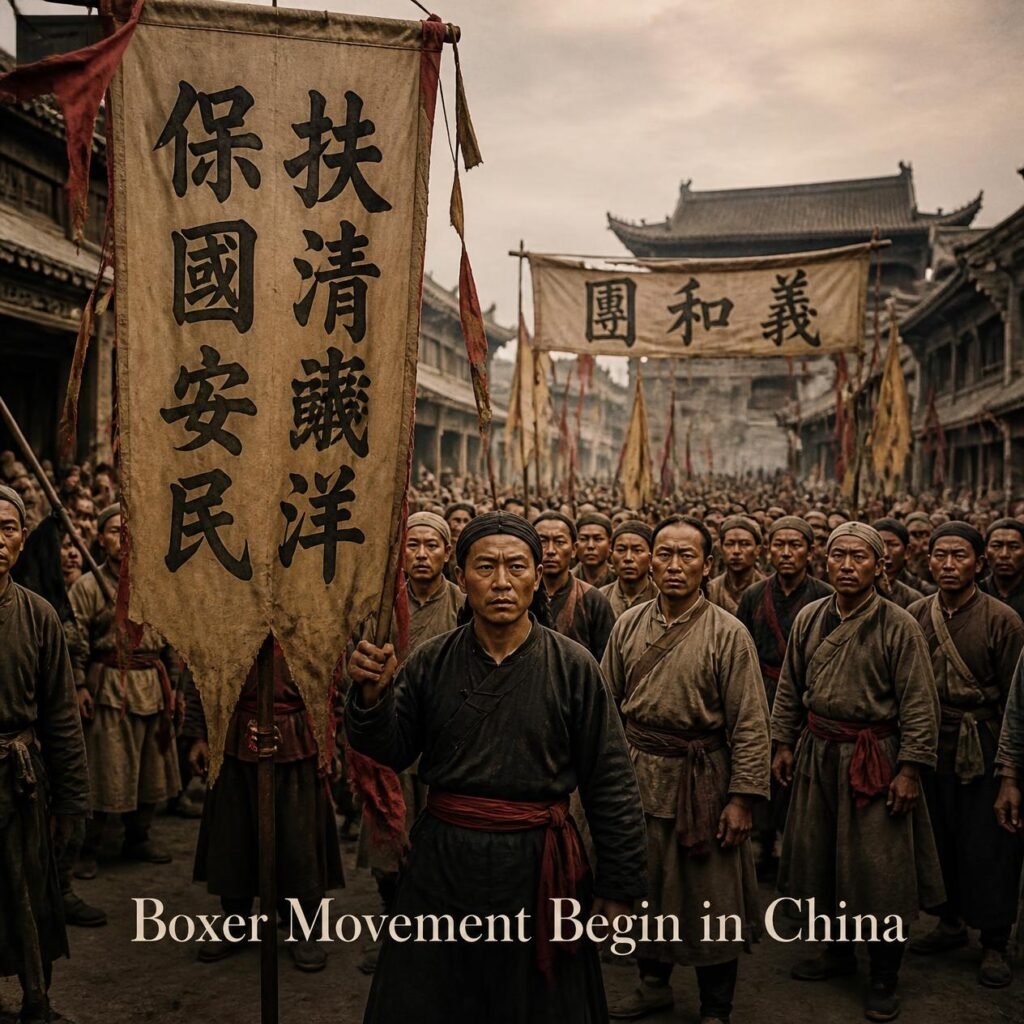
The Boxer Rebellion was an anti-foreign movement that included many local Chinese peasant groups, martial arts schools, and local organizations.
These people practiced what they believed to be a way of life that would keep them safe from western arms and invasion; it was a combination of traditional physical and spiritual practices.
Many Boxers felt that foreign presence in their country (particularly Christians) were invading China’s traditions.
While there were numerous reasons for the Boxer Rebellion on the local level, there were two major universal goals for the Boxer Rebellion.
One goal was to resist all forms of foreign control. The second goal was to preserve China’s ancient ways.
Foreign Influence in China
One of the primary causes of the Boxer movement was the increased presence of foreigners in china. Through out the 19th century european, russian and Japanese empires as well as many others acquired significant political and economical interest in china.
The foreign governments were granted various rights, including but not limited to;
- the right to trade with china
- lease land from china for use by china
- foreign governments
- grant concessionary railroads, etc.
Many chinese citizens felt this development threatened their national sovereignty.
As a result of foreign involvement in china’s internal affairs, and the ineffectiveness of the qing dynasty to stop this trend, a great deal of anger developed across all sectors of society.
The Impact of Christian Missionaries
Foreign missionaries were another significant source of strife. The missionary groups built churches, schools, and various other community structures throughout China.
While some Chinese welcomed the activity that was being done by the mission groups, many saw Christianity as a challenge to their long-standing traditions, customs and beliefs.
At times, converts to Christianity would have their lives protected or supported by the foreign missionaries they converted through;
this provided further cause for animosity toward those who did not convert.
Converts would at times find themselves involved with disputes with non-converts in addition to being involved in larger international disputes.
This animosity was one of the factors that grew into anti-Christian sentiment and assisted in creating an atmosphere where the Boxer movement could thrive.
Economic challenges were yet a second major force behind the Boxer Movement.
Northern China was in an economically dire situation; it had high rates of unemployment, many natural disasters that would disrupt the economy and limit available resources.
The most vulnerable population during these times were farmers because they often depended on their crops being successful or at least a good harvest to provide income.
In such an environment of dissatisfaction toward the foreign influences (foreign religions), Christian communities, and the Qing government’s inability to address issues facing them,
the Boxers provided a base of support by identifying themselves as protectors of Chinese society and all things Chinese.
Defeat and National Humiliation
China’s military losses in the 19th century also increased nationalist sentiment. The loss of the First Sino-Japanese War (1894-1895) was especially humiliating to China.
Japan had been considered weaker than China by the Chinese leadership; therefore, when they were defeated it showed how weak the government of the Qing Dynasty was, and how serious the fears were for the future of China.
Foreign powers continued to demand concessions from China and many Chinese citizens believed that at some point China would be divided into territories controlled by various countries.
These feelings of national humiliation fueled public support for movements which claimed to protect the nation against foreign control.
The Qing Government and the Boxers
Beginning of Text. At first, the Qing government thought that the Boxers were very hard to get control of so it was suspicious of them.
Eventually, however, some government officials realized that the Boxer Movement could be used to fight against the foreign influence.
This relationship would become much more important as the situation worsened.
The Boxer movement by 1900 had increased its attacks on foreign interests and Christian communities.
The Qing government would support the Boxers in confronting foreign governments.
Ultimately, this escalation turned what was originally a local movement into a global crisis.
The Boxer Rebellion of 1900
A large number of foreigners were killed by the Boxers, who attacked and destroyed foreign property, Christian missions and churches and all Chinese Christians during a short time span between 1899-1900.
In response to these attacks, foreign troops from eight countries came into China to defend their respective interests and nationals.
Eventually an international force defeated both the Boxer army and the Qing imperial army that was backing them.
FAQ
What was the Boxer Movement?
The Boxer Movement was a rebellion against foreign influence and Christianity in China during the late nineteenth century.
Why did the Boxer Movement occur?
The Boxer Movement occurred for several reasons.
Many Chinese were upset with foreign interference (politically, economically),
Christian missions in China, the poor state of China’s economy and the decline of the Qing Government.
In what region of China did the Boxer Movement start?
The majority of the Boxer Movement activity took place in Northern China, specifically in the province of Shandong.
Why did the Boxers hate foreigners?
Boxers thought that foreign nations had taken over much of China’s economy, political system
and land and threatened to destroy the way of life in China as it had existed for centuries.
Who or what were the targets of the Boxers?
Most boxers saw all forms of Christianity and most Christian missionary work as examples of western influence and intervention into Chinese affairs.
Conclusion
The Boxer Movement in China grew from the culmination of several key factors such as;
- Foreign intervention
- Economic hardships
- Anti-Christian feelings
- Weakness of Government
- Growing Nationalism among the Chinese population.
There wasn’t one specific reason that started the Boxer Movement but rather multiple reasons and events over many years prior to the outbreak of the Boxer Rebellion.
Military failures, loss of sovereignty through foreign concessions, rising social tension, and discontent toward the Qing government led to the emergence of the Boxer Movement.
The Boxer Movement will remain a significant aspect of Chinese history due to its representation of opposition to foreign control during a time of great turmoil and national crisis for China.
Although the Boxers were ultimately unsuccessful they did show how angry the public was and how urgently needed political and social changes were in China.