
The Blue People of Kentucky are among the most intriguing medical and historical accounts to be attributed to the region of Appalachia. For decades prior to the 1960s, members of the Fugate family of eastern Kentucky were well-known for having an unusual amount of blue pigmentation on their skin.
This peculiarity was so intriguing that it inspired curiosity from the local community as well as researchers into medicine which ultimately explained the basis of the coloration.
Who Were the Blue People of Kentucky?
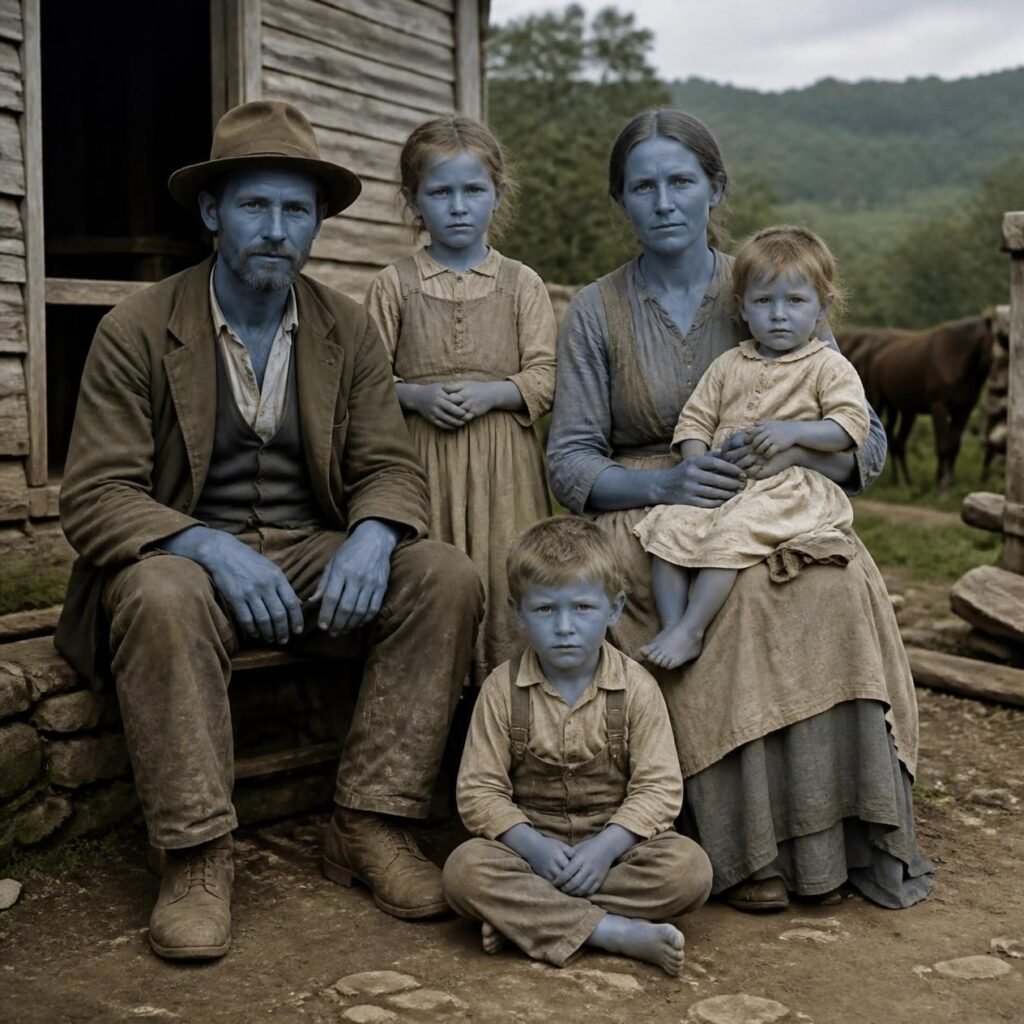
The Blue People of Kentucky is largely associated with the Fugate family who resided in the extremely rural, mountainous areas of Eastern Kentucky. In addition to their very unusual skin colors, the family members were able to pass on this condition to their children for multiple generations.
While most people have pink or brown skin tones, the Fugate family members had an obvious blue or grayish (slate) skin color; they usually displayed these shades on their mouth and limbs. The amount of blue varied among each family member.
Because the Fugates were living in a remote area, it made it difficult for them to gain access to physicians as well as advance testing.
Therefore, because of lack of knowledge and inability to obtain help, the strange condition turned into local legend.
What Caused Their Blue Skin?
A connection to a hereditary condition known as methemoglobinemia (meth-eh-mo-glo-bi-nee-mee-a) ultimately led to solving the case.
Methemoglobinemia is an unusual hereditary problem affecting how hemoglobin transports oxygen through the bloodstream.
Hemoglobin is the substance within red blood cells responsible for carrying oxygen to various parts of the body. In cases involving methemoglobinemia, a portion of the hemoglobin will be changed to methemoglobin.
Methemoglobin does not effectively deliver oxygen to body tissue like normal hemoglobin. If the level of methemoglobin increases significantly enough, it causes the skin and/or lips to have a bluish coloration.
Why Did the Fugate Family Have the Condition?
One of the most significant parts of the story deals with the family’s heritage. In Kentucky, members of the Fugate lineage had intermarried with other family members carrying the same genetic characteristics for the condition.
The implication is not that all family members were afflicted. A person inherits an expression of a condition based upon how they inherit specific versions (or “alleles”) of those genes from their parents.
Due to geographic isolation of this Appalachian community over several generations, there are likely many genes present in the population at levels high enough to be retained by families.
Thus, researchers were able to determine why the rare blue coloration occurred so frequently in descendant generations.
How Was the Mystery Solved?
A medical professional became involved with the study of this particular family through research conducted during the twentieth century by scientists investigating the family.
One of these physicians is well known today for his contribution to identifying the cause of the condition and studying the family — Dr. Madison Cawein.
Dr. Cawein’s involvement was as a researcher on the team looking at this family and eventually he was able to determine that the reason for their “blue” appearance had nothing to do with some sort of unusual pigmentation or a strange new disease.
The significance of Dr. Cawen’s work lay in transforming what many would have considered a local legend into an example of hereditary methemoglobinemia.

His findings also show how genetics, geographic location and family history may all contribute to our overall health.
Can Methemoglobinemia Be Treated?
Depending on the type and level of methemoglobinemia, it is possible to treat certain forms of methemoglobinemia with medicine.
Inherited types of methemoglobinemia have historically been treated differently than those that result from drugs, chemicals or exposure to other substances.
In the past, one common drug used as a treatment for several types of methemoglobinemia included methylene blue, which could restore a functional form of hemoglobin when there was an accumulation of methemoglobin.
Today, the decision regarding how to treat individuals diagnosed with methemoglobinemia will vary based on the reason they were exposed to methylene blue. Treatment decisions are best determined by trained healthcare providers.
The Fugate family’s experience brought awareness to this extremely rare genetic disorder and has increased overall knowledge of methemoglobinemia.
Legacy of the Blue People of Kentucky
The Blue people of Kentucky continue to be a notable element of Appalachian History today. While their story will always be remembered as an interesting medical anomaly,
it represents how remote communities can protect rare genetic features for multiple generations.
The Fugates’ unique appearance was the subject of some speculative and often times unfounded rumor at one time; however,
subsequent medical study provided the community with a rational explanation for what they had experienced.
The community’s story has been documented in both Medical Literature, Documentaries, Books and Articles discussing the culture and genetics of Appalachia.
Their story is also a reminder that individuals experiencing unusual physical features may have either complex genetic reasons, or other medical factors contributing to those differences.
Much like how these unusual features were mysterious before the advances of modern medicine, so too are the features themselves now better understood by continued research into the causes.
Final Thoughts
The Blue People of Kentucky, their blue skin color wasn’t some mysterious supernatural thing. Instead, they had a very rare genetic disorder called methemoglobinemia, which affects how the body transports oxygen and uses it in red blood cells.
Their story still fascinates many people today. They are so much more than just another piece of Kentucky history or Appalachian culture.
As both a scientific study of genetics as well as a study of how advances in medicine can solve mysteries that have been passed on from generation to generation, they are also a great example.