
One of the most iconic engineering feats in the history of aviation has captured the minds and imaginations of enthusiasts for generations. The Hughes H4 Spruce, also known as the Hughes H-4 Hercules, is the world’s largest and heaviest seaplane ever created with an incredibly large wing span and a massive wooden frame; it represents one of the ultimate examples of the “ambition” of genius inventors who pushed engineering boundaries.
Built during World War II, as America began to see that warships would be under attack from submarines and Germany had developed U-boats capable of sinking huge freighters carrying thousands of tons of military supplies at once, Howard Hughes saw a need for a fast, efficient way to transport troops and supplies across the Atlantic ocean. Hughes’ solution was to create an enormous aircraft able to carry hundreds of soldiers, their equipment, and even small tanks and other vehicles on board.
However, this gargantuan flying boat (the Hughes H4 Spruce) never flew again after its first short test flight in 1947 and never entered into active duty service. So what was the reason for building such an innovative plane using so much wood? What ultimately led to the demise of the Hughes H4 Spruce?
This is a story of vision, engineering technology, political obstacles and limitations.
What Is the Hughes H4 Spruce?
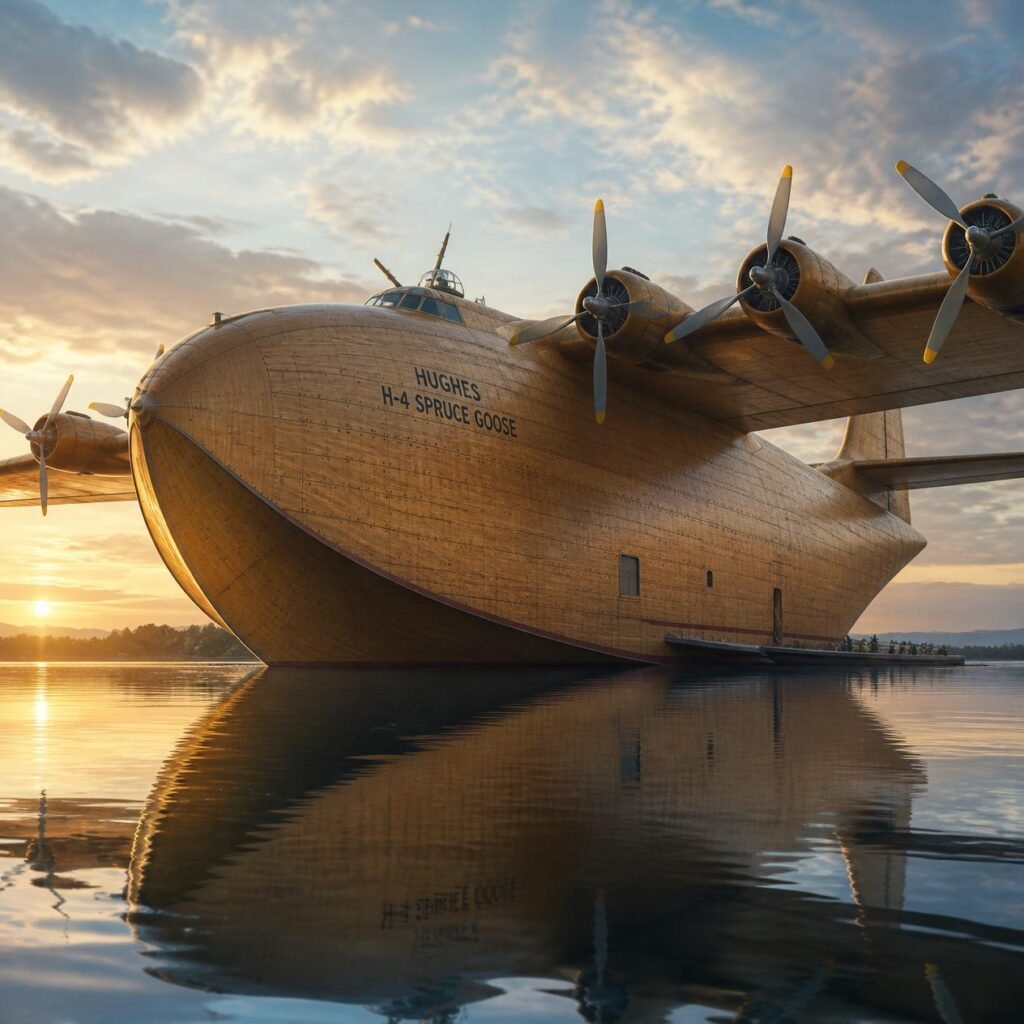
The term “Hughes H4 Spruce” is used to describe the famous aircraft that was officially called the Hughes H-4 Hercules. This was a massive flying boat made of wood which was developed by the Hughes Aircraft Co. during WWII.
The project for developing this airplane began with a request from the US government because at that time Germany had begun sinking many American troop supply ships on their route through the ocean. The threat of being attacked by enemy subs caused much concern about shipping goods via the sea.
To develop a method of moving great amounts of troops and supplies quickly over vast areas of water, the idea of building an airplane large enough to haul big cargo’s became apparent.
As a result of these concerns, the Hughes H-4 Hercules was developed.
The H-4 Hercules had the following characteristics:
- Wingspan of 320 ft. (approximately 97.5 meters)
- Length of around 218 ft. (approximately 66.6 meters)
- 8 large engines
- Composite structure made primarily of wood
- Ability to hold thousands of tons of people and/or other cargo
When completed, the Hughes H4 Spruce would be the biggest airplane ever constructed.
Even today, it will remain one of the largest flying boats ever constructed and one of the most recognizable airplanes in history.
Why Was the Hughes H4 Spruce Built?
Beginning with the early days of World War II, the history of the Hughes H4 Spruce can be traced back to when the U.S. had a logistics crisis. In 1942, the U.S. was shipping supplies to Allied forces all over the world by sea using thousands of ships. However, Germany’s Uboats sank many of these supply ships while they crossed the Atlantic Ocean.
Therefore, the U.S. government realized it needed another way to get its troops and military supplies overseas. Henry J. Kaiser proposed the construction of large cargo airplanes capable of transporting troops and their supplies across oceans rather than using vulnerable sea-going vessels. This is why Howard Hughes got involved; he was a well known industrialist/aviation engineer with a reputation for innovation in design and development of aircraft.
As such, the U.S. Government issued a contract to build a new large cargo airplane, which would be able to
- transport soldiers
- vehicles
- equipment, etc.
That would normally need to be transported by ship. The original name for this aircraft was HK-1 Hercules. It was developed through a partnership of the two parties:
- Henry Kaiser (industrialist) and his manufacturing capabilities
- Howard Hughes (aviation innovator/designer)
Eventually due to disputes between Kaiser and Hughes regarding direction of the project, Kaiser left the project. Howard Hughes then took sole responsibility for continuing the project, and renamed the plane the Hughes H-4 Hercules.
The Story Behind the Name “Spruce Goose”
The term “Spruce Goose” has become probably the most recognizable aviation nicknames in the world, yet it was a misnomer at best.
It was not spruce wood which comprised the major part of this aircraft.
Due to wartime metal shortages, the engineers were forced to use materials other than aluminum for the construction of the aircraft. A new type of laminate wood product called Duramold was developed.
Duramold was manufactured by stacking layers of birch wood and resin together under extreme heat and compression. This process produced an extremely light weight, yet very strong, composite of wood.
Components of this aircraft included:
- birch wood
- resin based composite products
- laminated wood components
The original intention behind the terms “Spruce Goose” was as sarcasm on the part of some journalists who questioned whether or not a large wooden airplane would be able to take flight.
Howard Hughes detested the nickname and felt that it indicated his aircraft was old-fashioned and poorly engineered.
Over time however, the term “Spruce Goose” became irrevocably linked to the aircraft.
Howard Hughes: The Man Behind the Giant Aircraft
The history of the Hughes H4 Spruce is inextricably linked with the man who made it possible.
Howard Hughes (1905) was a businessperson, engineer, movie producer, as well as an aviation enthusiast. His reputation as an innovator has been largely based on his willingness to push aircraft technology toward new boundaries.
He created many other innovations before designing the H-4 Hercules.
Prior to developing the H-4 Hercules, some of Hughes notable accomplishments include:
- Designing airplanes that were considered to be at least somewhat innovative.
- Achieving world airspeed records.
- Creating the Hughes Aircraft Company.
- Producing military aircraft for both the U.S. and foreign governments.
As mentioned above, Hughes was a perfectionist. He personally got heavily involved with design engineering and he would only accept projects if they met what he considered to be an exceptionally high standard.
While this approach to design produced some truly remarkable aircraft, it also often resulted in long delays and high expense.
Ultimately the H-4 Hercules (Spruce Goose), represented the extremes of all three of these characteristics;
- extreme ambition
- technically innovative
- expensive
- controversial.
To Hughes, the H-4 Hercules was much more than just another military project; it was an opportunity to test how far engineers could go in challenging their own limitations.
Engineering Largest Aircraft
To built Hughes H4 Spruce was a really big engineering challenge. At that time, airplanes were growing bigger but most big planes relied heavily on aluminum construction. The H Hercules had to be built differently because during wartime there was a shortage of aluminum and traditional construction was hard. Engineers developed advanced composite techniques for handling the aircraft’s huge size.
Duramold process enabled wood to take strong curved sections and produced smoother aerodynamic surfaces better than traditional wood construction.
Included in this aircraft were…
Massive Wings
The wingspan was 320 feet wide and longer than wings of many modern commercial airliners. Wings contained:
- Eight engines
- Fuel tanks
- Support structures
Strong engines
The Hughes H4 Spruce was powered by eight Pratt & Whitney R4360 Wasp Major radial engines.
Each engine produced roughly 3000 horsepower. Together these engines were powerful enough to lift this huge aircraft.
Lightweight Design
Despite the aircraft’s huge size engineers paid particular attention to reducing weight. Using wood composites helped:
- Reduce structural weight
- Preserve strength
- Increase manufacturing flexibility
Demonstrations showed alternative materials could be used effectively for large aviation projects.
Hughes H4 Spruce Specifications
| Feature | Details |
|---|
| Official Name | Hughes H-4 Hercules |
| Nickname | Spruce Goose |
| Manufacturer | Hughes Aircraft Company |
| Designer | Howard Hughes |
| First Flight | November 2, 1947 |
| Wingspan | 320 feet (97.5 m) |
| Length | 218 feet (66.6 m) |
| Height | 79 feet (24 m) |
| Engines | 8 × Pratt & Whitney R-4360 |
| Construction Material | Laminated wood composite |
| Type | Heavy transport flying boat |
| Crew | 3 |
| Status | Preserved museum aircraft |
Construction Delays & Controversy
Although the Hughes H4 Spruce was technically a great engineering success, there were several issues with the development of the aircraft.
The aircraft was to be built for military use, but the slow pace of the build meant by the time it was complete (in 1947), the military no longer needed an aircraft like the H4 Spruce.
Additionally, as the price tag for the project grew larger, the project became increasingly politicized.
There were many questions raised about it
- why so much money was being spent on an aircraft that could possibly never be used again.
- There were also many questions about how practical it is to build an aircraft of this size out of wood.
Finally, as the project continued, many people began to wonder if Howard Hughes was building the aircraft due to his own pride in what he was accomplishing.
Historic First Flight of the Hughes H4 Spruce
Finally, after many years of criticism, delays, and doubts from the public, the day of testing of the Hughes H-4 Spruce finally came to be. On November 2nd, 1947 thousands of people came out to see this massive aircraft being tested at the Port of Los Angeles in California.
Many thought that the aircraft would never get off the water. In fact some of the critics said the whole project was a total waste of money before they had ever seen the aircraft take to the air. Howard Hughes himself was inside the cockpit. Although he was not supposed to pilot the aircraft, he made the decision to take command of the aircraft during the taxi test. With him was several other crew members and engineers who were checking how well the aircraft was performing.
The first part of the test consisted of a high speed taxi test over the water. As the aircraft went faster and faster something entirely unexpected occurred. The Hughes H-4 Spruce took off from the water.
For nearly 26 seconds the world’s largest wooden aircraft flew through the air at an altitude of almost 70 feet (21 meters), covering less than a mile. Although the duration of the test was very short, it showed clearly that:
The world’s biggest wooden aircraft can fly!
Howard Hughes had shown that his unpopular aircraft was not a publicity stunt but actually worked as an airplane.
Why Did the Hughes H4 Spruce Fly Only Once?
One of the biggest mysteries surrounding the Hughes H4 Spruce (the largest airplane ever built) is why it was never flown after its construction was finished.
There are several factors that contributed to this question; all of them are interrelated.
The Second World War had ended
The primary reason the Hughes H4 Spruce was designed and constructed was as a troop/cargo carrier for use during wartime.
When the aircraft was finally completed in 1947, the second world war had ended nearly two years before.
Therefore, there was no longer any pressing need for a large cargo plane.
The military quickly began looking at other methods of transporting troops and supplies.
For example, they could now use much larger and better equipped cargo ships or conventional planes.
Jet technology began to advance rapidly in the late 1940’s
At the time the Hughes H4 Spruce was being designed, almost every plane used piston engines.
But when the Hughes H4 Spruce was nearing completion, new technology involving jets was beginning to appear on the scene.
- This new technology included:
- Faster travel speeds.
- Greater overall efficiency.
- Potential for long term development.
As a result, the future of aviation was headed towards smaller, faster and more efficient jet-powered airplanes rather than large flying boats with many piston engines.
In fact, the H-4 Hercules became one of those last remaining symbols of what was once a fast developing area of aviation history which had already passed into obsolescence.
Hughes H4 Spruce’s huge size compared to modern commercial airplanes
| Aircraft | Wingspan | First Flight | Main Purpose |
|---|---|---|---|
| Hughes H4 Hercules | 320 ft | 1947 | Heavy transport flying boat |
| Antonov An-225 Mriya | 290 ft | 1988 | Super-heavy cargo transport |
| Airbus A380 | 261.8 ft | 2005 | Passenger transport |
| Boeing 747 | 224.7 ft | 1969 | Passenger and cargo transport |
Interestingly, the Hughes H4 Spruce still has one of the greatest wingspans ever built.
Its size remains impressive even compared with modern aircraft.